

Your Attention Isn't Broken
It's being harvested. Here's the neuroscience of what's actually happening — and the architecture that fixes it.

Attention Is Not a Character Trait

You probably have a story about yourself and focus. Maybe you believe you’ve always been easily distracted. Maybe you remember a time when you could read for hours or work deeply for an entire afternoon, and you wonder what happened to that version of you. Maybe you’ve quietly concluded that you simply lack the discipline that other, more productive people seem to possess.
Almost none of that is accurate. What has changed is not you. What has changed is the environment your attention is trying to function in — and the degree to which that environment has been deliberately engineered to prevent the kind of sustained, deep focus that your most important work requires.
Attention is a biological resource. It is generated by the prefrontal cortex, the same region responsible for reasoning, planning, and emotional regulation. It has a finite daily supply that depletes with use and restores with genuine rest. And like every biological resource, it is subject to being overwhelmed, exhausted, and redirected by external forces that are more powerful than individual willpower.
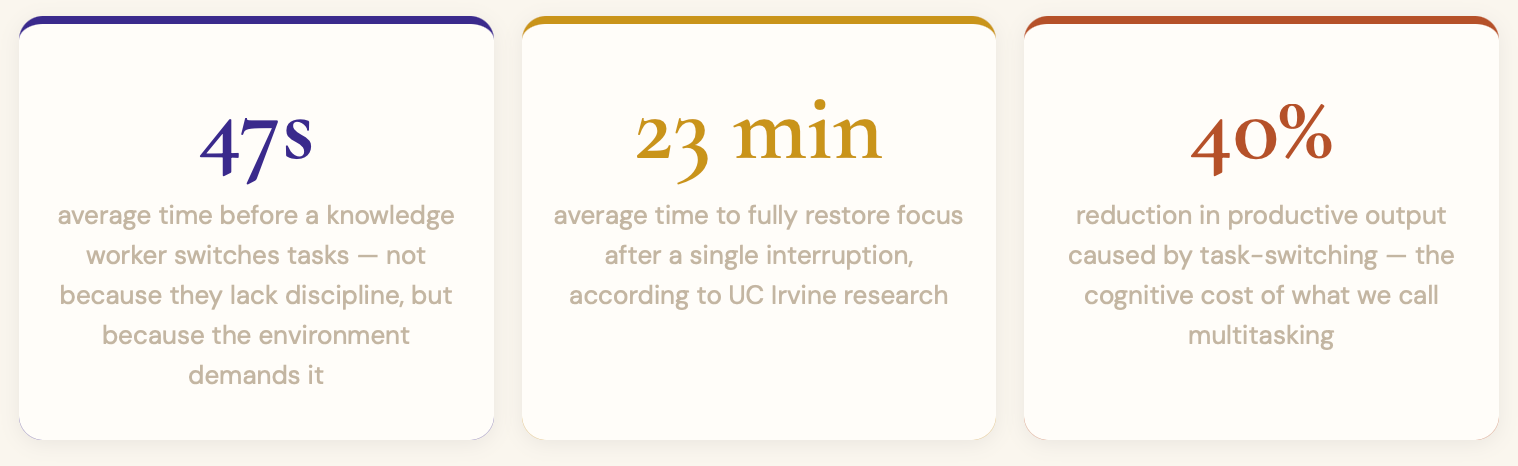
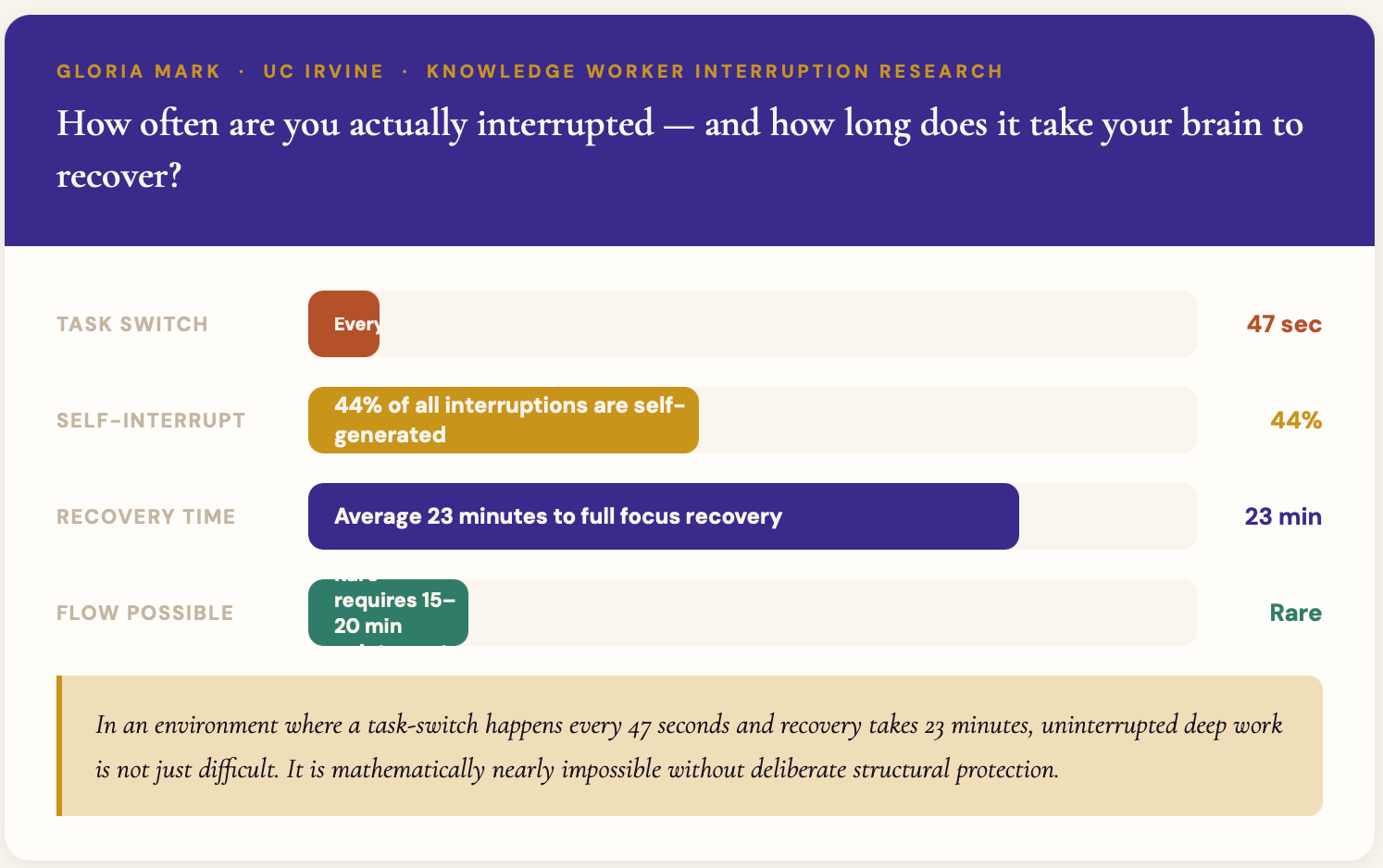
The modern attention environment is exactly that force. The average knowledge worker, according to research by Gloria Mark at UC Irvine, switches tasks every 47 seconds. Forty-seven seconds. Not because they lack discipline. Because the environment they are working in generates an interruption — a notification, a message, a tab, a sound, a question — approximately every 47 seconds, on average. And because the human brain, wired for threat-detection and novelty-seeking, is constitutionally unable to ignore those signals without significant deliberate effort.
“The problem is not that you can’t focus. The problem is that your attention is the product being sold — and you are competing against billion-dollar systems designed to capture it.”
The Myth of Multitasking

Before examining what fragmented attention costs, it’s worth dismantling the most persistent myth in modern productivity culture: that multitasking is a skill some people have and others lack.
The neuroscience is unambiguous. The human brain does not multitask. It task-switches — rapidly alternating attention between tasks in a way that feels simultaneous but is not. Each switch carries a cost. Researchers call it the attention residue effect: when you shift from one task to another, part of your cognitive resources remain oriented toward the previous task, still processing it, still holding it open. The new task receives a fraction of your actual attention even when it feels like you’re fully present.
The people who believe they are good at multitasking are, counterintuitively, the worst at it. A landmark Stanford study found that heavy media multitaskers — people who regularly juggle multiple information streams — performed significantly worse on tasks requiring attention filtering, working memory, and task-switching than people who rarely multitask. The people most confident in their ability to divide attention are the most impaired by doing so.
Research: Mark, G., Gudith, D., & Klocke, U. (2008). The cost of interrupted work: More speed and stress. Proceedings of the CHI Conference on Human Factors in Computing Systems. This study found that workers compensate for interruptions by working faster — but with significantly higher stress, frustration, and cognitive load, producing work of measurably lower quality.
What Fragmented Attention Actually Costs You
The consequences of chronically fragmented attention extend well beyond feeling scattered. They restructure the kind of thinking you are capable of.
Cognitive psychologist Mihaly Csikszentmihalyi spent decades studying what he called flow — the state of deep, effortless absorption in a challenging task that produces both peak performance and subjective wellbeing. Flow requires approximately 15 to 20 minutes of uninterrupted engagement to initiate. It requires the complete absence of interruption to maintain. And once broken, it takes an average of 23 minutes to fully restore, according to Mark’s research.
In an environment where the average task-switch happens every 47 seconds, flow is not just rare. It is mathematically nearly impossible. You are being interrupted faster than the recovery time from the previous interruption. The cumulative result is a working life conducted almost entirely in shallow cognitive water — responsive, reactive, never deep.
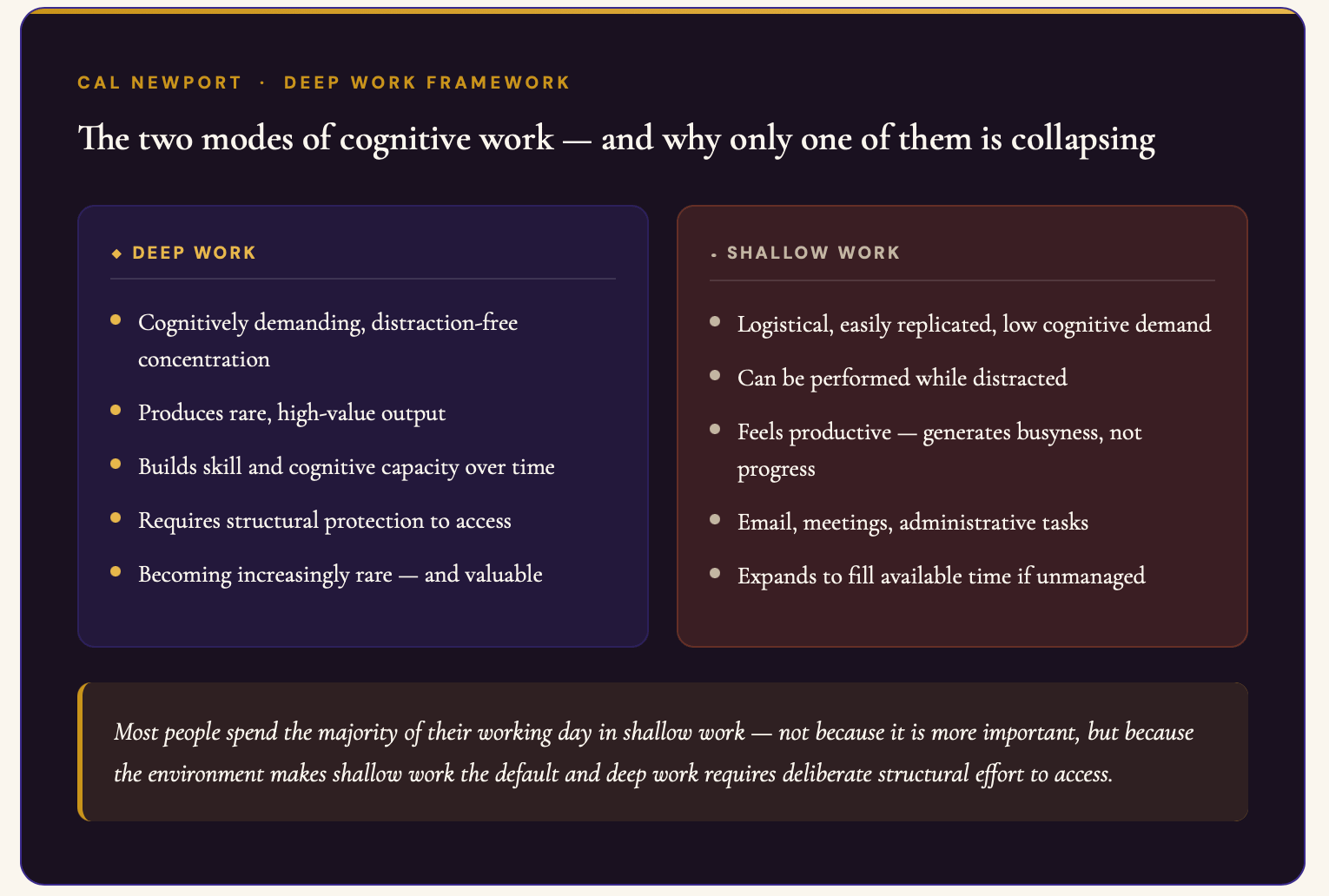
This matters for reasons beyond productivity. Deep, focused attention is not just how we work best. It is how we think most clearly, feel most competent, and experience the kind of meaning that sustained engagement with difficult problems produces. Cal Newport, drawing on decades of cognitive research, distinguishes between deep work — cognitively demanding work performed in a state of distraction-free concentration — and shallow work — non-cognitively demanding, logistical tasks that can be performed while distracted. The economic and personal value of deep work is enormous. Its availability is collapsing.
There is also a neurological dimension that rarely enters this conversation: chronic attention fragmentation appears to change the brain’s default mode of operation. Research by Michael Merzenich and others suggests that the brain is continuously being shaped by the demands placed on it — a principle called neuroplasticity. A brain trained for years on rapid task-switching and constant novelty-seeking becomes progressively less capable of the sustained attention it is no longer being asked to perform. Distraction, in other words, is a trainable habit. So is focus — but only if you practice it.
“In an environment where the average task-switch happens every 47 seconds, flow is not just rare. It is mathematically nearly impossible.”
The Attention Economy

The most important contextual fact about modern attention is this: your focus is a commodity. The business model of nearly every platform you use — social media, news, email, messaging — depends on capturing and holding your attention long enough to sell it to advertisers. The measure of success for these platforms is not your productivity, your wellbeing, or the quality of your thinking. It is time on platform.
The systems designed to capture your attention are built by teams of engineers and behavioral scientists using the most sophisticated persuasion technology ever created, informed by decades of research into human psychology, reinforcement learning, and neurological reward circuitry. The average person competing against these systems with nothing but willpower and good intentions is not failing at self-control. They are losing a profoundly asymmetric contest.
Understanding this changes the frame entirely. The question is not “why can’t I just put my phone down?” The question is: what structural changes to my environment will make sustained attention possible, regardless of my willpower on any given day?
Research: Ophir, E., Nass, C., & Wagner, A.D. (2009). Cognitive control in media multitaskers. Proceedings of the National Academy of Sciences, 106(37). This Stanford study found that heavy media multitaskers were more susceptible to interference from irrelevant environmental stimuli, had worse working memory, and were less able to filter out distractions than light multitaskers — despite believing themselves to be better at managing multiple information streams.
Designing for Depth: An Attention Architecture
The research is consistent on one point: focus cannot be sustained by willpower alone in an environment optimized against it. The solution is architectural — changes to the structure of your environment, your schedule, and your default behaviors that make sustained attention more likely without requiring constant active effort.
01 Protect a Deep Work Block Every Day
Before you open email, before you check messages, before you respond to anything: protect a block of time — ideally 90 minutes to two hours — for your most cognitively demanding work. Schedule it as you would an important meeting, at the same time each day. Research on circadian rhythms and prefrontal cortex function suggests that for most people, the first two to four hours after waking represent peak executive capacity. This is the window to protect most aggressively. Everything else — email, meetings, administrative tasks — should be pushed to the afternoon wherever possible.
02 Eliminate Notifications Entirely
Notification management — turning off some alerts while leaving others — is not sufficient. Research shows that merely knowing a notification has arrived (even if you don’t check it) is enough to disrupt ongoing cognitive work, because the brain cannot fully suppress the impulse to investigate novel signals. The only effective intervention is complete absence. During deep work blocks, notifications off means off: phone face-down in another room, email client closed, messaging apps quit. The goal is an environment in which interruption is structurally impossible, not merely inconvenient.
03 Work In Time Blocks, Not Open-Ended Sessions
Open-ended work sessions — “I’ll work on this until it’s done” — are cognitively expensive because the brain must simultaneously do the work and monitor when to stop. Time-blocked sessions — “I will work on this specific task for 90 minutes” — reduce that monitoring load and leverage the deadline effect: the documented tendency of cognitive performance to improve as a defined endpoint approaches. The Pomodoro technique (25 minutes of focused work, 5-minute break) is the most studied version of this approach. The specific intervals matter less than the principle: bounded, defined focus windows outperform open-ended ones.
04 Restore Attention with Genuine Rest - Not Passive Scrolling
Attention restoration theory, developed by Rachel and Stephen Kaplan, proposes that directed attention — the kind required for focused work — fatigues with use and restores through exposure to environments that engage ‘soft fascination’: gentle, effortless interest that doesn’t compete for cognitive resources. Nature, walking without a destination, quiet, unfocused looking — these restore attentional capacity. Passive social media scrolling does not. It places low-level demands on the same attentional resources you are trying to restore, preventing recovery while creating the subjective feeling of rest. A ten-minute walk outside is not a productivity hack. It is a direct neurological intervention.
05 Retrain Your Brain for Sustained Attention
If distraction is trainable, so is focus. The practice is simple but requires deliberate effort: regularly engage in activities that require sustained attention with no option for switching — reading physical books, long-form writing, extended single-task work sessions, or any practice that penalizes attention-switching. The goal is not just completing the activity. It is rebuilding the neural circuitry for depth that a decade of fragmented attention may have eroded. Start with 20 minutes of single-task focus and build incrementally. The discomfort you feel in the first few minutes of trying to sustain attention — the restlessness, the impulse to check something, the sense that you should be doing several things at once — is not evidence that you’re doing it wrong. It is evidence that the retraining is working.
Until next week,
Dr. Judy Ho
Clinical & Forensic Neuropsychologist · drjudyho.comUntil next week,
P.S. — If this resonated with you, forward it to someone who might be looking for ways to improve their attention.
The Savvy Psychologist Podcast

I’m thrilled to share that I’ve just launched my new podcast, Savvy Psychologist. Each week, I break down a psychological phenomenon in plain language, explain why it’s happening to you, and give you science-backed tools you can actually use.

Listen/watch my Savvy Psychologist podcast!
Take my attachment styles quiz
About me:
Dr. Judy Ho, Ph. D., ABPP, ABPdN is a triple board certified and licensed Clinical and Forensic Neuropsychologist, a tenured Associate Professor at Pepperdine University, television and podcast host, and author of Stop Self-Sabotage. An avid researcher and a two-time recipient of the National Institute of Mental Health Services Research Award, Dr. Judy maintains a private practice where she specializes in comprehensive neuropsychological evaluations and expert witness work. She is often called on by the media as an expert psychologist and is also a sought after public speaker for universities, businesses, and organizations.
Dr. Judy received her bachelor’s degrees in Psychology and Business Administration from UC Berkeley, and her masters and doctorate from SDSU/UCSD Joint Doctoral Program in Clinical Psychology. She completed a National Institute of Mental Health sponsored fellowship at UCLA’s Semel Institute.
Yes, attention fragmentation is often related to underlying dysregulation.
When the stress response cycle can't complete, the system stays in a state of low-grade threat detection, which makes sustained focus nearly impossible.
Thank you for this, Dr. Judy, and especially for your suggestions on retraining our brains. I'm at a stage in my life where I'm critically interested in this topic. You presented it in a thorough yet accessible fashion. Time for me to get to work!