The Sleep Optimization Protocol
A 7-day architecture for rebuilding the sleep your brain actually needs — based on what the neuroscience says works.


This month’s Elite resource is something I’ve been wanting to put together for a long time — not because sleep is a trendy topic, but because in two decades of clinical practice, I have never met a high-functioning person whose quality of sleep was not directly shaping the quality of everything else.
Not their relationships. Not their focus. Not their emotional regulation, their decision-making, their resilience under pressure, or their sense of who they are on a given day. Sleep touches all of it. And yet it is the first thing people sacrifice when life gets demanding — as if it were a luxury rather than the biological foundation that everything else is built on.
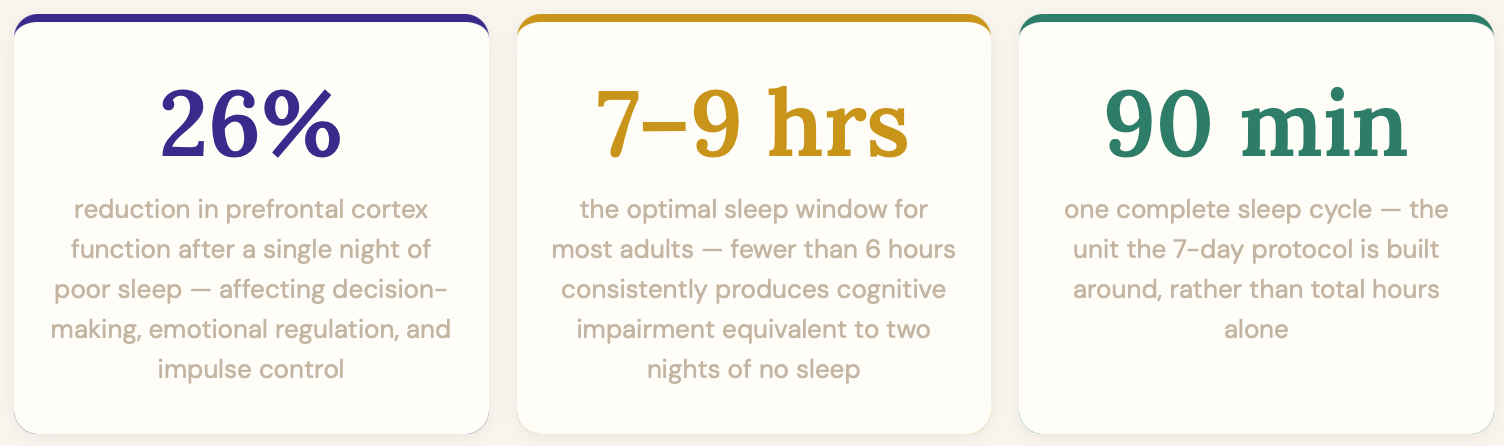
The frustrating thing is that most sleep advice is either too general to be useful (“go to bed at the same time every night”) or too medically focused to be applicable to the specific ways that high-performing, high-stress people tend to struggle with sleep. It’s rarely about sleep hygiene in the simple sense. It’s about cortisol that doesn’t come down. It’s about a default mode network that treats the moment the lights go out as an invitation to process everything that didn’t get addressed during the day. It’s about a nervous system that has been in sympathetic activation for so long that it genuinely doesn’t know how to shift into the parasympathetic state that sleep requires.
The protocol below addresses all of that. It is structured as a 7-day plan — not because sleep can be fixed in a week, but because the first week is the highest-leverage intervention point. These are the changes that produce the fastest, most measurable improvements in sleep onset, sleep depth, and next-day cognitive function. They are ordered deliberately: each day builds on the last, and skipping ahead rarely works as well as moving through the sequence.
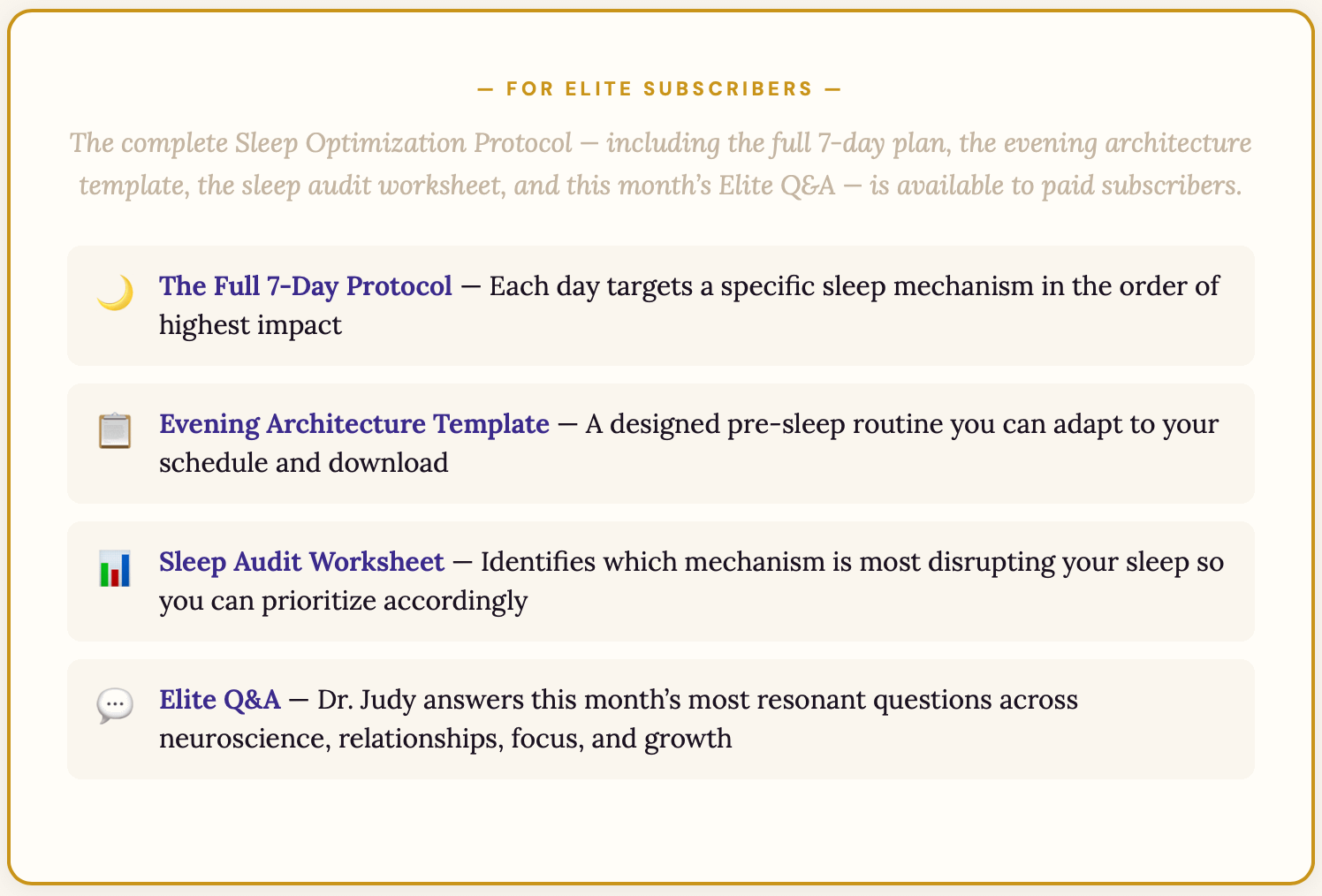
The complete 7-day plan, the evening architecture template, and the sleep audit worksheet are exclusive to Elite subscribers and accessible below.

Two Tips You Can Start With Tonight
Here are two interventions from the first 48 hours that you can begin tonight.
01 Build a 60 Minute Cortisol Buffer
Cortisol follows a predictable daily arc, designed to peak in the morning and reach its lowest point at night. Anything that activates the stress response in the hour before bed — work email, news, difficult conversations, intense exercise, or emotionally charged content — spikes cortisol at exactly the wrong moment and primes your threat-detection system for the night rather than rest. The single most impactful change most people can make is creating a genuine 60-minute buffer before bed: screens reduced, stimulation low, nothing that requires a decision or produces a stress response. This is not about winding down in a vague sense. It is about completing cortisol’s natural diurnal decline so that your brain arrives at sleep onset in a physiological state that actually allows deep sleep to initiate.
02 Do a Cognitive Offload Before You Lie Down
The default mode network — your brain’s resting-state system — activates the moment external demands cease. Left unguided, it defaults to reviewing unresolved material: open loops, unfinished decisions, social concerns, things that went wrong. This is not anxiety. It is your brain doing exactly what it was designed to do at exactly the wrong time. The intervention is simple: 10 to 15 minutes of structured writing before bed. Not journaling in the reflective sense — a straightforward cognitive dump of everything currently held in working memory. Every open task, unresolved concern, and pending decision goes onto the page. Your brain holds open loops because it is afraid of losing them. Give it somewhere to store them, and it will often release them. Research by Borkovec and colleagues demonstrated that scheduled ‘worry time’ earlier in the evening significantly reduces intrusive nighttime thought — the mechanism is exactly this.
The complete protocol is structured across seven days, each building on the last. Work through them in sequence — the order is deliberate and reflects the hierarchy of impact in the research.